
For Faculty

Fall 2012 DC Elk KnobThe Honors College encourages faculty from all majors, departments, programs, colleges, and schools to consider ways of becoming involved with the students in The Honors College, whether the students are currently in a related discipline or not. Offering unusual courses either at the introductory or upper division level can lead to exciting new paths of scholarship both for the faculty member and the students. Mentoring an Honors Thesis can lead to publishable findings or fundable projects, while also promoting the intellectual maturation of your junior colleagues. Just getting connected with this dynamic and intellectually ambitious group of students will stimulate ideas and directions that remind you of graduate school and the ferment of discovery.

How to Get Involved

If you are interested but are not sure how to start, just contact the Director and have a conversation about ways in which courses you teach or research you pursue could fit into The Honors College curriculum. Opportunities exist for everything from research courses to those involving travel abroad or service learning locally. The possibilities are only limited by your creativity.
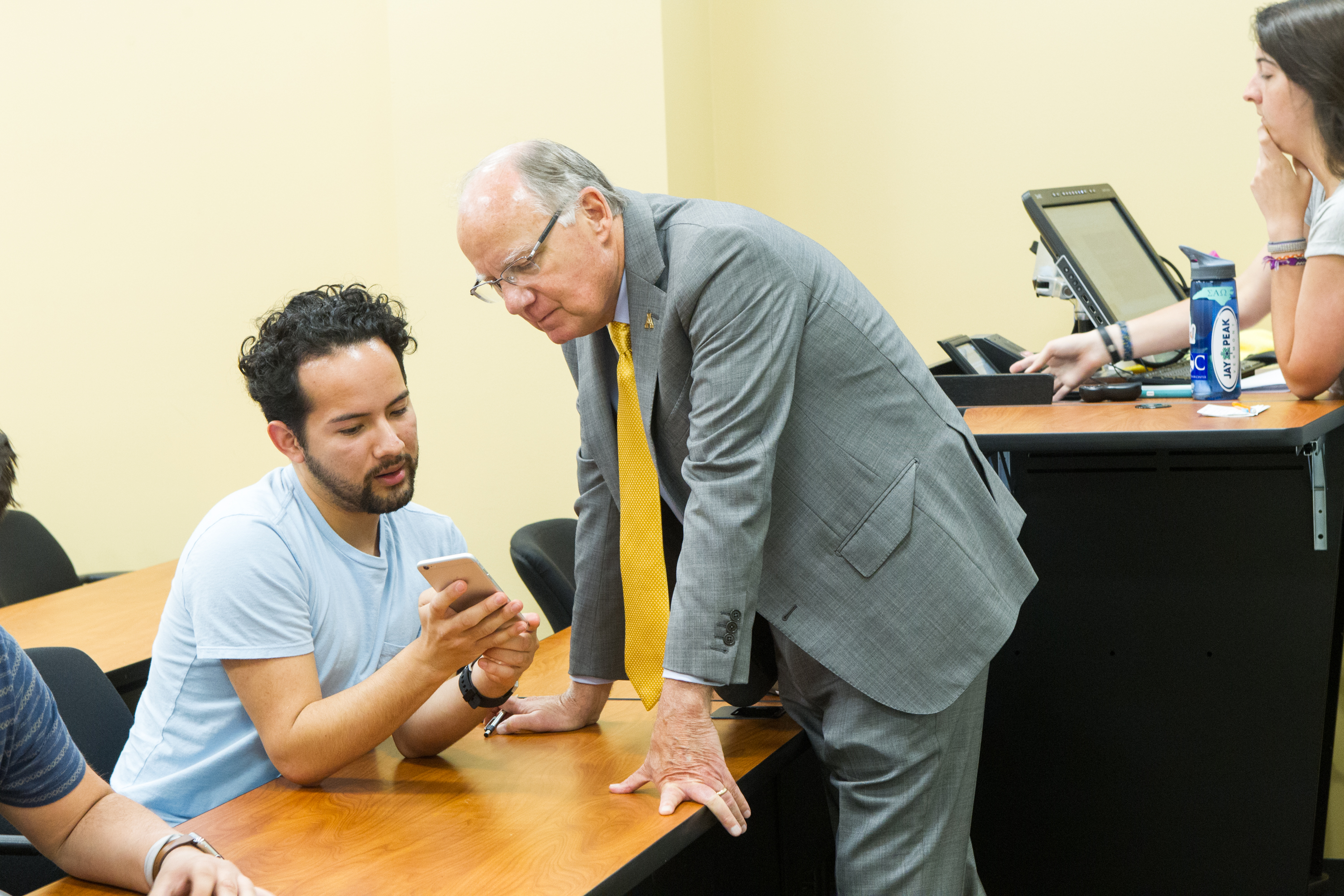

Teaching Honors Courses

The easiest way to become involved with Honors students is to offer an Honors course. This could be either an Honors-only version of a regular course from the faculty member's department (generally having a 410 suffix as designator so only Honors students may take the class), or an interdisciplinary Honors seminar course offered through The Honors College (so-called "HON courses") that is unusual, or more appropriate for graduate school-bound students. Note that HON courses must cross at least two of the three major disciplinary boundaries between humanities, natural science, and social science (e.g., English and Biology, or Francophone Studies and Marketing, or Education and Music).

The Honors College also has pre-purchased materials available for all Honors courses including the following materials:

Films (on DVD):

  • 9 (2009)
  • Alien Trilogy
  • Inspector Gadget 1 & 2
  • Matrix Trilogy & Animatrix
  • Robots (2005)
  • Star Wars Prequel Trilogy
  • Star Wars Trilogy
  • Terminator 2
  • The Adventures of Buckaroo Banzai
  • The King of Kong: A Fistful of Quarters
  • This Film is Not Yet Rated
  • Wall-E
  • War of the Worlds (2005)
  • War of the Worlds (1953)

Senior Thesis/Project

The Honors Thesis/Project is the capstone experience of The Honors College and generally represents a student's work over two or more disciplines. It is usually the most fulfilling aspect of the undergraduate curriculum for Honors students as they, with their director's guidance, get to determine their own course of study and original scholarship. The faculty member who is asked to mentor an Honors Thesis/Project knows they are getting one of ASU's best students who has chosen to collaborate with them on a shared area of intellectual interest. While this is similar to a Master's thesis in terms of time and effort invested, the opportunity to work with these gifted and highly motivated students has its own rewards beyond the possibility of a presentation-worthy result.

The Honors Thesis/Project takes whatever form best suits the subject. It can be a traditional research paper; it might resemble a scientific research article. A creative project, composition, work of art, recital, or dramatic production is also appropriate. The scope and length of the work will fall somewhere between a typical semester paper and a Master's thesis. The style is appropriate to the format and is agreed upon between the student and the faculty director.  Whether the product is written or not, there must be a written componenet describing the project to accompany any non-written product (e.g., a performance DVD, or photos of art work, or a graphic design product).

The Honors Thesis/Project is usually three credit hours and may be in the student's major or minor, but this is not a requirement. The work should be interdisciplinary with at least two professors helping to mentor the work: a First Reader, or Director, and a Second Reader. The two professors usually are full-time ASU faculty (the Director must be, but the Second Reader may be from outside ASU), and they must come from different departments; this opportunity encourages inter-departmental collaboration and communication, which is part of the mission of The Honors College. The work must be presented at the end and "examined" in the form of a thesis defense with the committee. While it is recommended that the defense be public (announced appropriately and held in a place where others could attend), this is at the discretion of the committee.

If you are interested in directing a University Honors Thesis/Project but would like more information, please do not hesitate to contact the Honors Office (honors@appstate.edu) or contact the Honors Director (phone #2083).