
Honors College students travel to Coban, Antigua, and Copal AA La Esperanza, Guatemala to study education and sustainability

Dr. Greg McClure, professor in the Department of Learning, Teaching, and Curriculum, and Dr. Christopher Van Loan, professor in the Department of Child Development, Literacy and Special Education led Honors College students to Coban, Antigua, and Copal AA La Esperanza, Guatemala, July 20 - 31, 2025. In this Faculty Led Education Abroad Program (FLEAP), students earned three semester hours of credits for HON 3515 Education and Sustainability in Indigenous Guatemala. They met the Honors College international education requirement, which asks students to broaden their perspectives as they consider global interconnectedness through exploring other cultures, worldviews, and frames of reference.
Copal AA is a multilingual and multiethnic Indigenous community of Mam, Q’anjob’al, Q’eqchi’, and K’iche Maya people. The community was founded by 86 refugee families in January of 1996 during the last year of the internal armed conflict in Guatemala. It is a community of about 1,000 people, located along the Chixoy River about 30 miles south of the Mexican border in the Alta Verapaz Department of Guatemala.

Hope Spurlock is a Chancellor’s Scholar double-majoring in gender, women, and sexuality studies and sociology, who joined the Honors College at App State in the Fall 2023 semester and plans to graduate in May 2027. She explained that in Copal AA, she and the other students were paired up to stay with host families in the community. Their living situations varied, but all the families were prepared to host. As she explains, they “took us into their homes with understanding and openness. They knew we were not used to their lifestyle or living conditions, and made sure we were comfortable and felt welcome. They were also understanding if we could not communicate as well as we would have liked. Our professor, Dr. McClure, made sure to pair students who did not speak Spanish well with those who did. So that was very helpful in being able to communicate with our host families and overall navigate the community.”
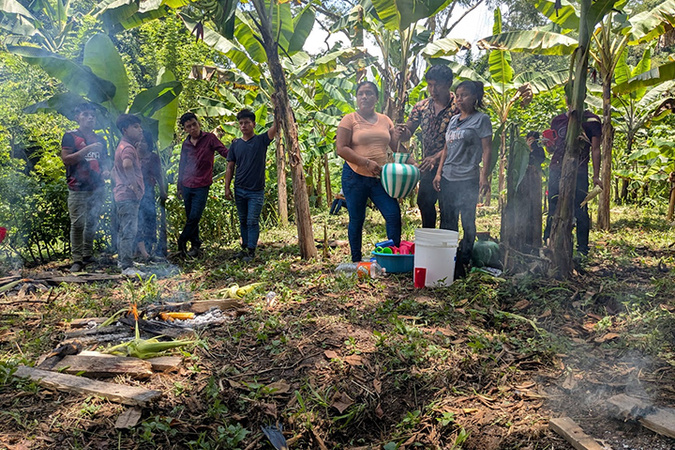
In this study-abroad course, students engaged with the Copal AA community to collaboratively learn about education and sustainability. Their activities included: meeting with the local town council members to learn about their customs, comparing cultures with middle school students, trips along the River Chixoy, and more.
The Honors College international education requires students to
- Reflect on their interactions with individuals and communities from cultural backgrounds different from their own and explain how these cross-cultural experiences have supported their individual personal, academic, and/or professional growth.
- Cultivate cultural competence and humility by examining the importance of understanding, respecting, and valuing difference in building inclusive communities and addressing global challenges collaboratively.
- Apply a holistic approach to global engagement that encompasses intellectual, cultural, and social dimensions as they explore, discover, learn, and grow with others.
Spurlock reflected on this experience and the importance of study abroad:
Studying abroad is something I believe everyone should have the opportunity to experience. Being able to immerse yourself in a new culture and lifestyle is important in shaping a person's understanding of the world. Not only how we ourselves exist within it, but also how other people across continents exist within it. By being able to observe these different lifestyles and grow even a small understanding of them, I was able to see life from a different perspective. There are varying cultures across continents that we barely begin to understand through our history classes and textbooks. The more we expose ourselves to them, the easier it is to begin to understand how people experience their lives and the foundations that lead to their views on the world.
Dr. McClure provided further context about the Copal AA community and the value of visiting and learning from them.
“Visiting the community of Copal AA La Esperanza is always an inspiring and humbling experience. Copal AA is a multilingual and multiethnic Maya community... They are survivors of the Guatemalan genocide of the 1980s and spent more than a decade in refugee camps in southern Mexico. The community is a model for intentional living guided by principles of sustainable development. What's beautiful for our students is that far from the theoretical notions we learn about in the classroom, in Copal AA we witness these principles in action every day we are there. We walk through lush permaculture fields that make use of natural herbicides and fertilizers. We eat freshly picked organic fruits and vegetables that burst with flavor and nutrients. We observe Maya elders teaching the youth cultural practices and traditions dating back thousands of years. Perhaps most importantly, we participate in community conversations around global concerns like climate change and migration. In the end, I believe students come away from the experience with a sense of hope, inspired that it is possible to live in harmony with the earth.”
Honors College students like Spurlock experienced boundless learning and growth on this FLEAP as she shared, “Trying to explain these experiences to my family and friends has not been easy. There is so much to be said, from the structure of the buildings and the rough gravel road, and the everyday trek up a mountain to their family's land to retrieve wood or crops for the day, to the spiritual strength that the community of Copal AA has, and their overall ability to adapt and push back against our everyday norms. Yet I struggle to find the words, or to even process how to explain the fight this community has gone through, and still puts up, to push back against climate change, genocide, and government isolation. I truly believe there are no words that I could use to justify it, at least not now, and not in the English language.”
She further explained that,
Copal AA allowed us into their community, their homes, and their lives. They shared their food, drinks, ceremonies, weavings, land, river, and beds with us. Their kindness shows no bounds, even after so much has been taken from them. To be able to be a small part in sharing their story, even in a way that is uniquely me, a me that is still struggling to find the words, is such an honor.